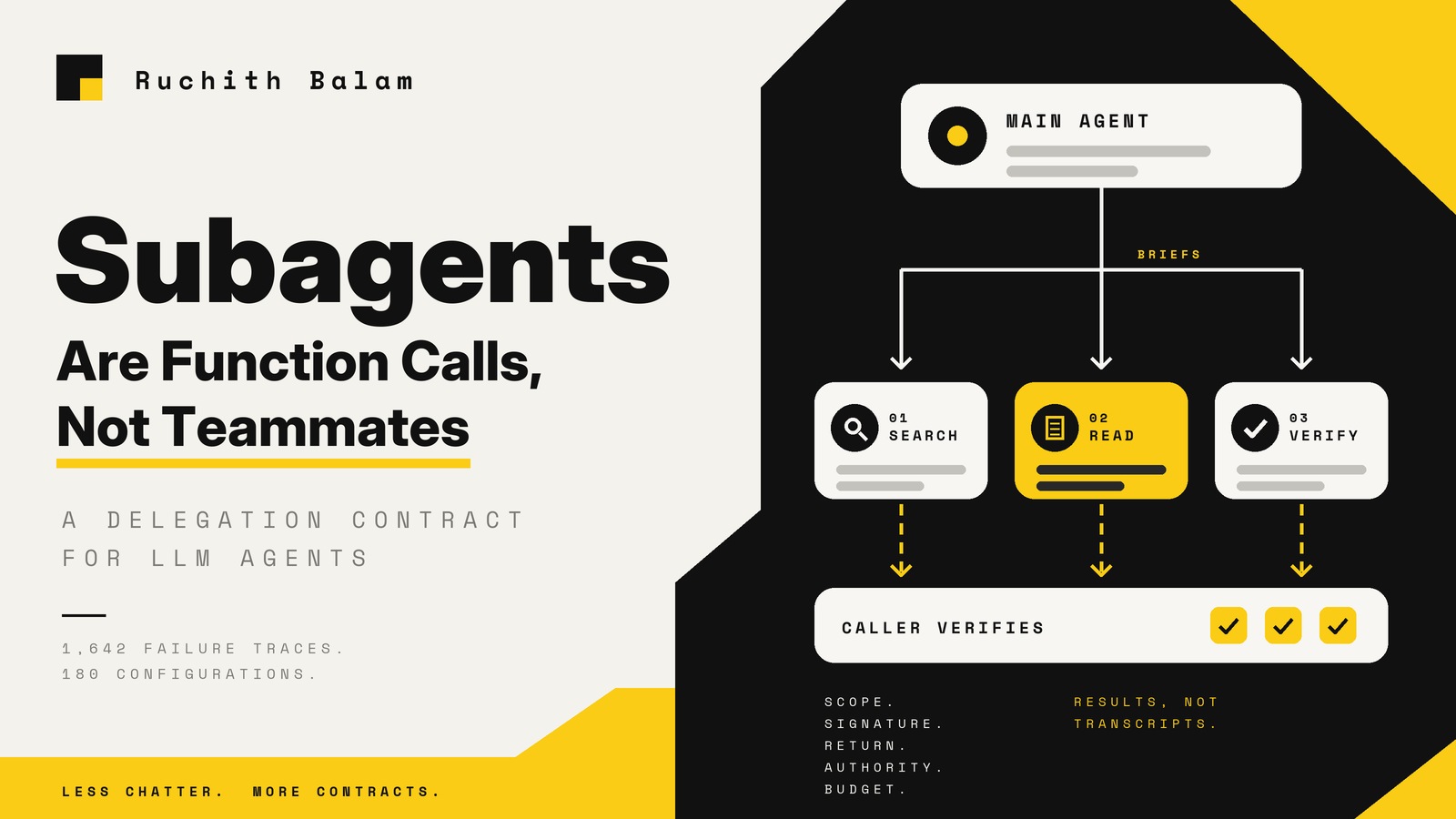
In a controlled study of 180 agent configurations, researchers at Google, Google DeepMind and MIT gave the same orchestrator design, a main agent coordinating subagents, two different jobs. On financial analysis it scored 80.8% higher than a single agent working alone. On step-by-step planning in Minecraft it scored 50.3% lower. Same models, same token budget, same architecture.
The difference was not the models. It was whether the work split into independent pieces, and whether the hand-offs between agents suited what language models actually are. One idea explains both results: a subagent is a function call, not a teammate. Give it a precise signature, get back a typed result, keep shared decisions and side effects with the caller, and stop within a budget. Designed that way, and used only where work decomposes, subagents deliver the gains Anthropic and others report. Designed like a conversation between colleagues, they reproduce the failures documented across 1,642 traces in a NeurIPS 2025 study. Research through September 2026 points the same way.
What a subagent buys you
Language models have a finite working memory. Anthropic calls it an attention budget: the more a context window holds, the less reliably the model recalls any one part of it. An agent that searches, reads files and inspects logs fills that budget fast with material it will never need again.
A subagent is the standard answer. It does the noisy work in its own context window, with its own instructions and tools, and hands back a short result. In Anthropic's research system a subagent may spend tens of thousands of tokens on a question but returns a summary of often 1,000 to 2,000 tokens, so the main agent's context stays on the request, the plan and the conclusions.
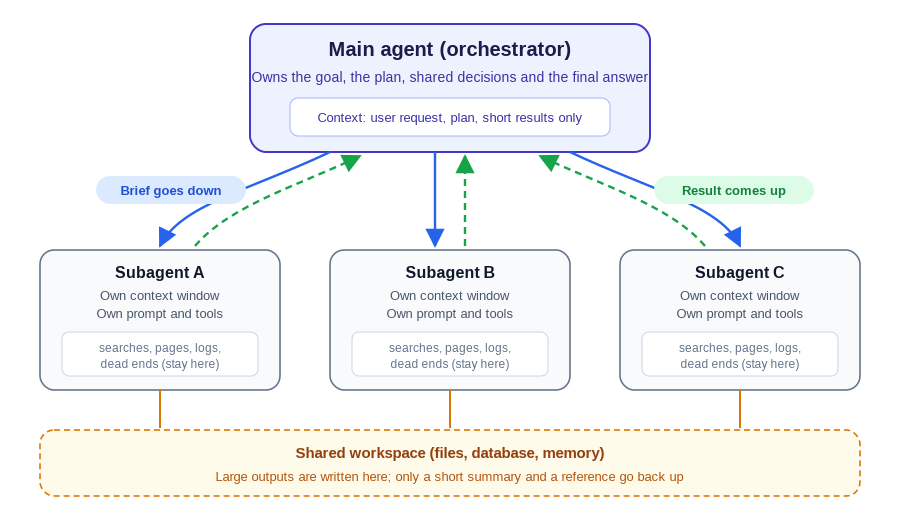
The payoff can be large: Anthropic's system, an Opus 4 lead with Sonnet 4 subagents, beat a single Opus 4 agent by 90.2% on its internal research evaluation. So can the price: about 15 times the tokens of a chat. On BrowseComp, token usage alone explained 80% of the variance in performance, so much of the gain is simply more reading, done in parallel.
The pressure: what the evidence shows
If subagents were a free upgrade, controlled comparisons would show steady gains. They do not. The Google study fixed the reasoning-token budget and compared one agent with four multi-agent arrangements across four benchmarks and three model families. Figure 2 shows the centralized arrangement, a main agent coordinating subagents.
Show the data
| Benchmark | Task type | Single agent | Change with orchestrator |
|---|---|---|---|
| Finance-Agent | Parallel analysis | 0.349 | +80.8% |
| BrowseComp-Plus | Web research | 0.318 | +0.2% |
| WorkBench | Business tool use | 0.629 | −1.2% |
| PlanCraft | Sequential planning | 0.568 | −50.3% |
Three findings from the same study shape the rest of this article.
- Sequential work breaks. On PlanCraft, where each step depends on the last, every multi-agent variant lost 39% to 70%.
- Strong single agents gain little. Above roughly 45% single-agent success, coordination gave diminishing or negative returns, the authors' baseline paradox.
- The hand-off structure matters. Independent agents with concatenated outputs amplified errors 17.2 times; an orchestrator that checked results held it to 4.4 times.
Show the data
| Architecture | How agents interact | Error amplification | Successes per 1,000 tokens |
|---|---|---|---|
| Single agent | One loop, one context | 1.0× | 67.7 |
| Centralized | Orchestrator coordinates and validates | 4.4× | 21.5 |
| Hybrid | Orchestrator plus peer messages | 5.1× | 13.6 |
| Decentralized | Peers debate to consensus | 7.8× | 23.9 |
| Independent | No communication, outputs concatenated | 17.2× | 42.4 |
Efficiency agrees: a single agent produced 67.7 successful outcomes per thousand tokens, the centralized design 21.5. Coordination has to buy accuracy a single agent cannot reach.
The NeurIPS 2025 paper Why Do Multi-Agent LLM Systems Fail? came at it from the failure side. Annotating 1,642 traces from seven open-source frameworks, its authors found failure rates of 41% to 86.7% and 14 failure modes, and concluded that failures are "not merely a function of challenges in the underlying model." They come from how systems are specified, how agents align and how results are verified.
Show the data
| ID | Failure mode | Category | Share |
|---|---|---|---|
| FM-1.3 | Repeats completed steps | System design | 15.7% |
| FM-2.6 | Reasoning and actions don't match | Inter-agent misalignment | 13.2% |
| FM-1.5 | Doesn't recognise when to stop | System design | 12.4% |
| FM-1.1 | Ignores task constraints | System design | 11.8% |
| FM-3.3 | Verification done incorrectly | Task verification | 9.1% |
| FM-3.2 | Verification missing or incomplete | Task verification | 8.2% |
| FM-2.3 | Drifts from the task goal | Inter-agent misalignment | 7.4% |
| FM-2.2 | Proceeds on assumptions instead of asking | Inter-agent misalignment | 6.8% |
| FM-3.1 | Terminates too early | Task verification | 6.2% |
| FM-1.4 | Loses conversation context | System design | 2.8% |
| FM-2.1 | Unwarranted conversation reset | Inter-agent misalignment | 2.2% |
| FM-2.5 | Disregards other agents' input | Inter-agent misalignment | 1.9% |
| FM-1.2 | Breaks its assigned role | System design | 1.5% |
| FM-2.4 | Withholds needed information | Inter-agent misalignment | 0.85% |
What the 2026 research adds
Most of the evidence above is from 2025. Since then the question has shifted from "do multi-agent systems work?" to "when, and who decides to split?". These 2026 studies change how the contract below should be applied.
- Kimi K2.5 Agent Swarm (Moonshot AI). An orchestrator trained with reinforcement learning runs up to 100 frozen subagents over up to 1,500 steps, up to 4.5 times faster than one agent. Training had to overcome serial collapse, the orchestrator doing everything itself, and speed is measured in critical steps, the slowest path only.
- Anthropic's parallel-agent C compiler. Sixteen agents with no orchestrator wrote a 100,000-line compiler that builds Linux 6.9, for just under $20,000. It worked while many independent failing tests could be claimed, and stalled on the single kernel build: "every agent would hit the same bug, fix that bug, and then overwrite each other's changes."
- AOrchestra (arXiv 2602.03786). Defines each subagent as instruction, context, tools and model, created on demand by the orchestrator: 16.28% above the strongest baseline on GAIA, SWE-Bench and Terminal-Bench.
- AdaptOrch (arXiv 2602.16873). Picks a parallel, sequential, hierarchical or hybrid topology from each task's dependency graph: 12 to 23% above a fixed topology with the same models.
- Tran and Kiela (arXiv 2604.02460). With thinking tokens held equal, single agents "consistently match or outperform" multi-agent systems on multi-hop reasoning; multi-agent systems become competitive only when a single agent's use of its context is degraded.
- Uno-Orchestra (arXiv 2605.05007). A learned policy decides whether to split at all and which model takes each piece: 77.0% across 13 benchmarks, 16% above the best workflow baseline, at about a tenth of the cost.
- OrchBench (arXiv 2607.25656). Scores plans without running workers (r = 0.816 with real runs) and finds that "preserving task-critical information is more important than simply increasing the number of agents."
- SoK: When Safe Agents Fail Together (arXiv 2609.00595). Across 197 security studies, systems that pass information and authority between agents create "failures that local checks may miss."
Together they refine the picture in four ways.
- Delegate for context, not for more minds. At equal budgets one agent reasons as well; subagents earn their place when one context window would be overloaded.
- Not delegating is a design choice. The best 2026 orchestrators gain by choosing when to split, while Kimi had to train away the opposite failure.
- Parallel writing can work, but only when a near-perfect verifier splits the artifact into independently checkable units, as in the C compiler.
- Orchestrators are becoming trained components, which makes the interface between caller and subagent the thing worth getting right.
The root cause: the teammate mental model
Most of these failures share a source. Multi-agent systems are usually built as teams: a manager and specialists who talk, divide the work and help out. Human teams work because members share tacit context: the project's history, the audience, the unwritten conventions, and the habit of asking.
Agents share none of that unless it is written into their context. A subagent knows only the text it was given, not the conversation behind it, the decisions already made or the other subagents' work. Treated as a teammate, it fills the gaps with plausible assumptions, which is exactly what the failure data shows:
- They repeat completed steps (15.7%) because nobody said what was done.
- They don't recognise when to stop (12.4%) because "help with this" has no finish line.
- They ignore task constraints (11.8%) and drift from the goal (7.4%) because the constraints and the goal never reached them.
- They proceed on assumptions instead of asking (6.8%), Cognition's Flappy Bird failure: one subagent drew a Super Mario background, another a bird that matched neither. In Cognition's words, "actions carry implicit decisions, and conflicting decisions carry bad results."
The teammate model also invites expensive designs: peer-to-peer debate carried 263% coordination overhead in the Google study, and the hybrid design 515%, while amplifying errors more than the centralized one.
The better model: delegation as a function call
Software already has a reliable way to hand work to a component that cannot see the caller's state: the function call. It has a signature that states what it needs, returns a known type, does not change shared state behind the caller's back, and runs within limits. The caller decides what to do with the result.
This model explains the evidence. The centralized design, closest to a caller with functions, contained errors best because the orchestrator checks each result before anything builds on it. Independent agents, like functions writing straight to shared output, compounded errors most. And sequential planning resists delegation for the same reason a tightly coupled algorithm resists being split into functions.
The contract below turns this into five clauses, each aimed at a documented failure.
The delegation contract
Clause 1. Scope: delegate only work that decomposes
Delegation makes sense when a sub-problem can be solved without knowing what the others decided. That mostly means read-heavy work: searching, reading, extracting, comparing, checking. "What does vendor X charge?" and "what does vendor Y charge?" combine cleanly; the screens of one app or the sections of one argument do not, because each carries choices the others must match.
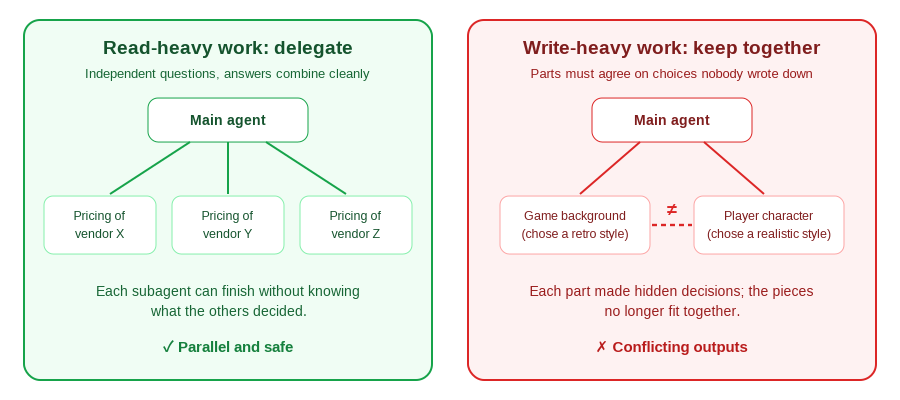
Two checks belong here: keep sequential tasks in one agent, and expect little from coordination when a single agent already succeeds above roughly 45%.
The C compiler is the exception for write-heavy work. A test suite turned one compiler into many small, independently checkable tasks, each claimed with a lock file, and its author notes the verifier had to be "nearly perfect." When the work collapsed into one task, the kernel build, parallelism stopped helping until a known-good compiler split it again. A strong automatic check is what lets a write-heavy task decompose.
Clause 2. Signature: the brief states everything the subagent needs
The brief is the subagent's entire world. Anthropic found that vague instructions made subagents misread tasks and duplicate searches, and settled on four required parts: an objective, an output format, guidance on tools and sources, and clear boundaries. The failure data adds two: what is already known, and why the task matters. AOrchestra's 2026 results show the value of making that structure explicit.
Side by side:
# Teammate-style brief
Research the semiconductor shortage.
# Function-style brief
OBJECTIVE Find the main forecasts for automotive chip supply
in 2027-2028 and the assumptions behind them.
WHY The user is deciding whether to sign a 2-year supply
contract. Pricing is covered elsewhere.
KNOWN The 2021 shortage is already covered. Do not research it.
SOURCES Analyst reports and manufacturer statements from the
last 12 months. No news aggregators.
BOUNDARIES Report findings only. Do not recommend a decision.
RETURN ResearchResult (schema below), max 300 words.
BUDGET 10 searches. Stop early if sources start repeating.Clause 3. Return type: results, not transcripts
A subagent should return what a function returns: a value the caller can use without reading the internals. That means the findings, their sources, a confidence level and what remains unresolved, ideally within Anthropic's 1,000 to 2,000 token range. A fixed schema makes results comparable, which is what lets the caller check them.
{
  "findings": [
    {"claim": "...", "source": "https://...", "date": "2026-08-14"}
  ],
  "disagreements": ["Forecast A assumes ..., forecast B assumes ..."],
  "confidence": "medium",
  "open_questions": ["No 2028 figure from manufacturer C"],
  "artifact": "workspace/supply-forecasts.md"
}
The artifact field handles large outputs: the subagent writes them to a shared store and returns a reference, which avoids what Anthropic calls a game of telephone. OrchBench found the same in general form: preserving task-critical information matters more than adding agents.
Clause 4. Authority: the caller owns shared decisions and side effects
A subagent that makes a decision other parts depend on is the same bug as a function that silently changes global state. Shared choices, such as structure, audience, interfaces or naming, belong to the caller and should be fixed before it fans out. A subagent that meets one should report it as an open question.
Side effects stay with the caller too: sending messages, writing to production, spending money and deleting data, all behind explicit checks. A subagent reading web pages can absorb planted instructions and carry them to the main agent, which holds stronger tools, so every return value is data to evaluate, never instructions. The 2026 security review explains why per-agent safeguards are not enough: when authority crosses agent boundaries, safe agents can fail together, and the caller is where those paths can be traced and closed.
Clause 5. Budget: every call has limits
Functions have timeouts; subagents need them too. Not knowing when to stop is 12.4% of MAST failures, and early versions of Anthropic's system spawned 50 subagents for simple questions. Each brief needs a tool-call budget, a token or time limit and a stop condition, and the system needs caps on fan-out and nesting. Under a fixed budget, per-agent reasoning gets too thin beyond three or four agents. Anthropic's rule of thumb: one agent with 3 to 10 tool calls for fact-finding, 2 to 4 subagents for comparisons, more than 10 only for complex research.
Two 2026 results sharpen this. Kimi measures speed by the slowest path, so an extra subagent counts only if it shortens it. And Uno-Orchestra's gains come from first deciding whether to split at all: the cheapest correct budget is often zero subagents.
And the caller verifies
Callers check return values; multi-agent systems often skip it. Missing checks, wrong checks and stopping early together make up about a quarter of MAST failures, and adding one objective check to a software-building framework raised its success rate by 15.6%. That validation step is why the centralized design contained errors best.
| Clause | What it states | Failure modes it targets (MAST share) |
|---|---|---|
| Scope | Only independent sub-problems: read-heavy work, or write-heavy work split by a near-perfect automatic check | Conflicting outputs from parallel writing; sequential tasks degraded 39 to 70% |
| Signature | Objective, why, what is known, sources, boundaries | Repeats steps (15.7%), ignores constraints (11.8%), drifts from goal (7.4%), loses context (2.8%) |
| Return type | Short structured result, evidence, confidence, open questions, artifact reference | Withholds information (0.85%), reasoning and actions don't match (13.2%), detail lost in summaries |
| Authority | Caller owns shared decisions and side effects; returns are data | Proceeds on assumptions (6.8%), breaks role (1.5%), injected instructions |
| Budget | Tool calls, tokens or time, stop condition, fan-out and depth limits | Doesn't know when to stop (12.4%), over-delegation, runaway cost |
| Caller verifies | Checks each result against the objective before using it | Missing verification (8.2%), wrong verification (9.1%), stops too early (6.2%) |
The contract in code
As an interface, the contract looks like this sketch, which is illustrative rather than tied to one framework:
import json
from dataclasses import dataclass, field

@dataclass
class Brief:                      # Clause 2: the signature
    objective: str
    why: str
    known: list[str]
    sources: str
    boundaries: str
    max_tool_calls: int = 10      # Clause 5: the budget
    max_return_words: int = 300

@dataclass
class Result:                     # Clause 3: the return type
    findings: list[dict]          # {"claim", "source", "date"}
    open_questions: list[str] = field(default_factory=list)
    confidence: str = "medium"
    artifact: str | None = None

def delegate(brief: Brief, run_subagent) -> Result:
    raw = run_subagent(brief)                 # separate context window
    result = Result(**json.loads(raw))        # reject malformed returns
    for f in result.findings:                 # caller verifies
        if not f.get("source"):
            raise ValueError("finding without a source: " + f["claim"])
    return result                             # data, never instructions

# Clause 1 and 4 live in the caller: it decides what to split,
# fixes shared decisions first, and keeps every side effect.
Frameworks supply the mechanics. Claude Code gives each subagent its own context, prompt, tool allowlist and model, and limits nesting; OpenAI's Agents SDK offers agents as tools, which matches the function-call model, alongside handoffs. The content of the contract, the scope, brief, schema and checks, is still yours to design.
Should this task get subagents?
The evidence reduces to seven questions. Answer them for a task you have in mind.
| Question | Points toward subagents | Points toward one agent |
|---|---|---|
| Can the work be split into parts that don't depend on each other's decisions? | Yes | No |
| Is it mainly reading, searching or checking, or producing one integrated artifact? | Reading and checking | One artifact |
| Is it a sequence where each step depends on the last? | No | Yes (multi-agent lost 39 to 70%) |
| Does a single agent already do it well (above about 45%)? | No, it struggles | Yes (gains diminish) |
| Is the result valuable enough to pay several times the tokens? | Yes | No (about 15× the tokens of a chat) |
| Would the side material flood the main agent's context? | Yes | No |
| Can each part be checked automatically (tests, a validator, a known-good reference)? | Yes (it can make write-heavy work splittable) | No |
Putting the contract to work
For a research task such as a market analysis, the contract gives every step one owner.
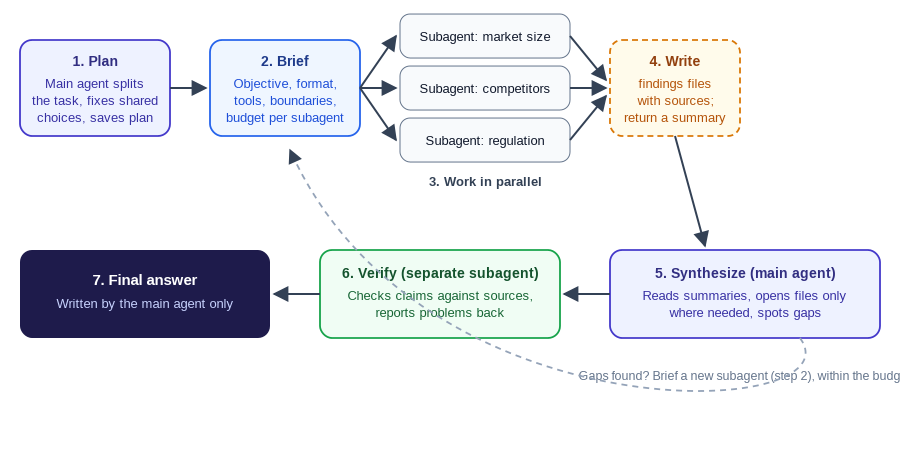
To measure it, Anthropic suggests starting with about 20 real queries, scoring against a rubric (factual accuracy, citations, completeness, source quality, tool efficiency), judging the end state rather than the path, and keeping a person in the loop. Log every brief and every return, since most failure modes show up there, and track successful outcomes per thousand tokens to see whether coordination earns its cost.
From more agents to better interfaces
The debate about multi-agent systems has mostly been about quantity: whether to add agents, and how many. The evidence asks a different question. The same design gained 80% on one benchmark and lost half its performance on another, and most failures came from how agents were specified and connected, not from the models inside them. Reliability depends on the interfaces between agents more than on their number.
That is good news, because interfaces are something engineers know how to design: a precise signature, a typed result, one owner for shared state, a budget and a check on every return. Cognition's warning still holds for work that cannot be cleanly divided. For work that can, treating each subagent as a function call rather than a colleague is what turns the extra tokens into better answers.
The 2026 research shows where this is heading. As orchestrators are trained rather than prompted, learning when to split, how wide to go and when to stop, the contract becomes the interface those systems are optimised against.
Sources (current to October 2026)
- Google Research, Google DeepMind and MIT, Towards a Science of Scaling Agent Systems: When and Why Agent Systems Work (arXiv 2512.08296, December 2025), and the Google Research summary. Source of Figures 2 and 3, the 45% threshold and overhead figures.
- Cemri et al. (UC Berkeley and others), Why Do Multi-Agent LLM Systems Fail? (NeurIPS 2025). Source of Figure 4, the 41 to 86.7% failure rates and the 15.6% verification result.
- Anthropic, How we built our multi-agent research system (June 2025): the 90.2% result, token usage, delegation and scaling rules, and evaluation advice.
- Anthropic, Effective context engineering for AI agents (September 2025): attention budget, context rot and the 1,000 to 2,000 token return range.
- Cognition, Don't Build Multi-Agents (June 2025): shared context, implicit decisions and the Flappy Bird example.
- Moonshot AI, Kimi K2.5: Visual Agentic Intelligence (January 2026): Agent Swarm, PARL training, serial collapse and critical steps.
- Nicholas Carlini, Anthropic, engineering post on building a C compiler with 16 parallel Claude agents (February 2026).
- Ruan et al., AOrchestra: Automating Sub-Agent Creation for Agentic Orchestration (arXiv 2602.03786, February 2026).
- Yu, AdaptOrch: Task-Adaptive Multi-Agent Orchestration in the Era of LLM Performance Convergence (arXiv 2602.16873, February 2026).
- Tran and Kiela, Single-Agent LLMs Outperform Multi-Agent Systems on Multi-Hop Reasoning Under Equal Thinking Token Budgets (arXiv 2604.02460, April 2026).
- Cui et al., Uno-Orchestra: Parsimonious Agent Routing via Selective Delegation (arXiv 2605.05007, May 2026).
- Ren et al., OrchBench: Evaluating Multi-Agent Orchestration Plans in Isolation via Deterministic Simulation (arXiv 2607.25656, July 2026).
- Yang et al., SoK: When Safe Agents Fail Together: The Security of Multi Agent LLM Systems (arXiv 2609.00595, September 2026).
- Anthropic, Claude Code subagents documentation, and OpenAI, Agents SDK: agent orchestration: how current frameworks implement delegation.
Figures 2 to 4 re-plot numbers published in the sources above; no new experiments were run for this article. Several 2026 papers are preprints; figures are as reported in their abstracts and posts. Percentages in Figure 4 are shares of annotated failures as reported in the MAST paper.